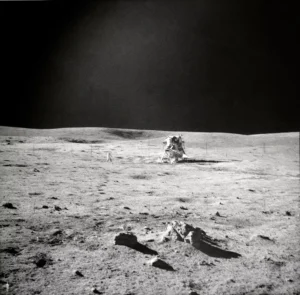
Discarded SpaceX Falcon 9 upper stage impact
Open Lunar Registry: SpaceX Falcon 9 Upper Stage Impact Zone
Categories: Impact Zone | Space Debris | Current Spacecraft Impact Sites
Overview
At Lunar Resources Registry we continuously map and monitor all human activity on the Moon; Who, Where, What, When. Recently SpaceX conducted an IPO, many financial pundits can see the SpaceX company valuation going to the Moon, but instead a discarded SpaceX Falcon 9 Upper Stage literally got there.
Technical Aspects
August 5, 2026, at approximately 06:35 UTC, a spent SpaceX Falcon 9 upper stage will impacted the lunar surface. It was originally launched in January 2025 to carry commercial lunar landers to the Moon, and gravitational forces and solar radiation pressure altered the orbital dynamics of the discarded upper stage, and cast it into a lunar collision trajectory.
The spacecraft impact site is quite violent, and hopefully leads to a big, beautiful crater…
Estimated Impact Location: Lunar Western Limb, in the vicinity of the Einstein and Bell craters. To be confirmed – LRR note.
Impact Velocity: ~8,700 km/h (5,400 mph).
Geospatial Impact Assessment: The kinetic impact is projected to generate a new lunar crater measuring 20 to 30 meters (65–90 feet) in diameter and approximately 5 meters deep. NASA’s Lunar Reconnaissance Orbiter (LRO) is expected to capture remote sensing data and before-and-after imagery. A follow-up high-quality image of this new crater will be hard to source but we can only hope – LRR note.
The CisLunar and Lunar Perspective
As soon as the impact happened the usual news articles appeared lamenting the environmental impact, but this specific event was unintended, and damages nothing of value. If it wasn’t reported, it would never be known to the general public.
Unplanned impacts like this do underscore the necessity for innovative infrastructure solutions, such as our proposed Space Debris Lunar Landing Zone (Space Debris Graveyard). However, unintended impacts are the last to be steered or even have their own propulsion, so we add this to the latest in a growing list of Spacecraft impacts on the Moon.